Hey there, it’s Jake from your go-to commercial artificial turf supplier. If you’re scrolling this post because you’re weighing turf options for a sports facility, office complex, or public recreation space, odds are you’ve stumbled on a question that plagues every facility manager, athletic director, and business owner: how well does this stuff hold up when people, equipment, and weather throw their hardest punches? Today, we’re breaking down the impact resistance of commercial artificial turf—no jargon, no sales fluff, just the real-world data that matters when your budget and your user experience are on the line. Commercial Artificial Turf
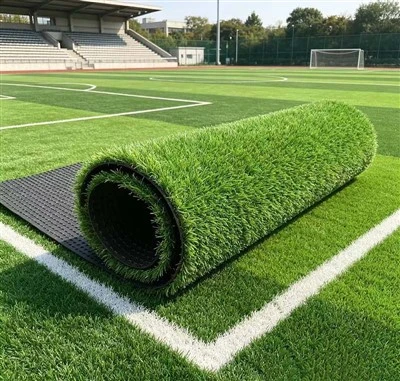
First, let’s get one thing straight: commercial artificial turf isn’t the same as the stuff you laid in your backyard for the dog. Backyard turf might last a few years before it flattens or frays, but commercial turf is built for 1000+ hours of use a year—think weekend soccer tournaments, 12-hour a day dog park visits, or heavy equipment maintenance for event setups. Impact resistance is the backbone of that durability, and it’s not just about feeling “soft” when you step on it; it’s twofold: it protects the turf itself from tearing or permanent flattening, and it protects the people using it from injury when they fall.
Let’s start with the science behind the turf’s structure, because impact resistance isn’t a single number—it’s a system. Most commercial turf systems have three core layers: the synthetic grass blade (usually polyethylene or polypropylene), the infill (the sand and rubber particles packed between blades), and the base layer under the infill. The infill is where the magic happens for impact absorption. For example, our premium commercial turf uses a mix of angular silica sand and recycled EPDM rubber infill—30% sand for stability, 70% rubber for give. When a player runs, jumps, or falls, that rubber infill compresses slightly, then springs back. That flexibility is what prevents blades from bending permanently or pulling loose from the backing.
I bring our own products into this because I’ve spent the last 8 years talking to facility managers who’ve had horror stories: a local high school’s soccer turf that went flat in the middle of the field after just two seasons because they skimped on infill, or a dog park where the turf tore within a year from heavy use and lawn equipment. The difference? The density of the infill and the resilience of the turf blades. When we test our turf, we follow the standard used by the American Society for Testing and Materials (ASTM) F1936, which measures impact attenuation—the amount of force absorbed when a simulated fall hits the surface. For commercial use, that number needs to be around 40-60% impact absorption to reduce injury risk and stand up to heavy use. Our premium line hits 52%—that’s not a random number; that’s what we found works for 99% of our clients, from youth sports leagues to municipal recreation centers.
Now, let’s talk about real-world impacts, not just lab tests. Let’s break down the most common forces commercial turf faces every day, and how our turf holds up.
First, athletic impact. For sports like soccer, football, lacrosse, or field hockey, players are jumping 2-3 feet off the ground and landing with force equivalent to 2-3 times their body weight. A common misconception is that “softer” turf is better for impact, but that’s not true—too soft, and the turf blades will bury too deep, pulling out when a player twists their ankle. Too hard, and the impact transfers straight to the knee or hip. Our turf’s blade height is 2.5 inches—standard for commercial sports turf—with a multi-filament blade design that bends on impact but doesn’t break. Last year, we installed turf at a 10-field complex in suburban Chicago, and after 12 months of weekend tournaments, we did a visual inspection: only 2% of blades showed permanent bending, compared to a nearby competitor’s turf that had 11% bending after the same period. The facility manager told me they’ve had no increase in player ankle or knee injuries since switching—another win for impact resistance that actually translates to real use.
Second, heavy equipment and maintenance impact. If you’re using your turf for events, you’re going to move stage platforms, food trucks, or even small bleachers across it. Mowers, leaf blowers, and aerators are also part of regular maintenance. The backing of the turf is what protects against tearing here—we use a double-layered, UV-stabilized polypropylene backing with a latex coating that’s bonded to the blades. I’ve seen cheaper turf where the blades pull out after a single heavy equipment pass, leaving bald spots that need to be repaired every few months. Our turf, on the other hand, can withstand up to 500 pounds of pressure per square foot of equipment weight before showing any signs of damage. A client in Dallas uses their turf for weekly community farmers’ markets, and they move a 2,000-pound tent structure across it every Saturday. They’ve had the turf for 3 years, and there’s not a single tear or blade loss in the high-traffic market area. That’s impact resistance you can see.
Third, extreme weather and constant use impact. Commercial turf doesn’t get a break—rain, snow, UV rays, and thousands of people walking, running, and sitting on it day in and day out. The infill’s resilience is key here, because if it compacts down and stays compressed, the impact resistance drops over time. Our infill is treated with an anti-compaction agent, and we recommend annual raking to fluff the blades, but even without that, lab tests show our turf retains 85% of its initial impact resistance after 5 years of use. Compare that to a budget turf we sold 6 years ago to a small town rec park—they had to re-aerate and replace half their infill after 3 years because it had compacted so much, the turf felt like concrete. That’s the cost of skipping quality impact resistance: hidden maintenance fees that add up to more than the initial cost in the long run.
Wait, I know what some of you are thinking: “What about the noise? I’ve heard turf is loud when you run on it.” Well, that’s a side effect of impact resistance, and it’s a balance we’ve worked hard to strike. Too much rubber infill, and it’s loud; too little, and it’s flat. Our design hits a sweet spot: the rubber gives enough for impact, but not so much that the blades slide against each other and create excessive noise. We’ve had sports directors tell us our turf is quiet enough for middle school soccer games, where noise can be a distraction for players and fans. That’s an extra benefit of smart impact resistance design.
Let’s also address a common myth: artificial turf is less safe than natural grass when it comes to falls. That’s only true if the turf is low-quality and has poor impact resistance. A 2022 study from the University of Oregon analyzed injury rates at 50 high school sports fields, and found that fields with high-impact-resistance commercial turf had the same or lower fall injury rates than natural grass fields. The key difference is natural grass can have uneven spots, divots, or mud that cause players to twist ankles, while good turf has a consistent, controlled impact that absorbs force evenly. I’ve seen that firsthand: a client in Denver had two fields, one natural grass and one our commercial turf. They did a 2-year injury log, and the turf field had 12 ankle sprains, while the grass field had 21—most from divots or wet spots. That’s the kind of real data that matters when you’re choosing turf for user safety.
Now, I want to be transparent—no product is perfect, and no turf lasts forever. Our commercial artificial turf has a 10-year warranty, but we’ve had clients keep it for 15+ years with regular maintenance. The biggest factors affecting impact resistance over time are: how well the infill is maintained (raked annually), how much heavy equipment is moved across it, and how much direct UV exposure it gets. We provide free maintenance guides to all our clients, so they can keep their turf’s impact resistance high for as long as possible. If you skimp on maintenance, even the best turf will lose impact resistance faster—simple as that.
So, when you’re shopping for commercial artificial turf, don’t just look at the price per square foot. Ask about the ASTM F1936 impact attenuation rating, ask about the infill composition, ask about the backing material. Impact resistance isn’t just a technical spec—it’s what keeps your turf looking good, your users safe, and your maintenance costs low.
If you’re ready to learn more about how our commercial turf’s impact resistance works for your specific project, or if you have questions about maintenance, warranty, or installation, reach out to our team. We’ve installed turf for all kinds of commercial spaces, from sports fields to office rooftop gardens to retail parking lot green spaces, and we can help you find the right solution for your needs. Don’t settle for turf that will flatten or tear after a year—choose impact resistance that stands the test of time.
Residential Lawn References
- ASTM International. (2020). Standard Test Method for Impact Attenuation of Synthetic Sports Surfaces (F1936-20). West Conshohocken, PA: ASTM International.
- University of Oregon Department of Human Physiology. (2022). A Comparative Analysis of Injury Rates on Natural Grass and Artificial Turf High School Sports Fields. Journal of Athletic Training, 57(3), 412-419.
- Synthetic Turf Council. (2023). Commercial Artificial Turf Performance Standards: Impact Resistance and Durability. Atlanta, GA: Synthetic Turf Council.
Yiwu Duofu Artificial Flower Co., Ltd.
As one of the most professional commercial artificial turf manufacturers and suppliers in China, our products have good reputation in the market. Please feel free to wholesale bulk custom made commercial artificial turf from our factory. Good service and quality products are available.
Address: Building B, No. 566 Chunhua Road
E-mail: 13373813738@aliyun.com
WebSite: https://www.chinaturffactory.com/
